Have you ever lost power at home and suddenly realized how many things depend on electricity?
Your phone needs charging, the Wi-Fi router goes offline, laptops need power, and even a small refrigerator can become a concern during a longer outage. The same problem can happen when you're camping or traveling: you want the convenience of electricity without carrying a noisy fuel generator everywhere.
A Portable Power Station can provide a practical solution, but choosing the right one isn't always straightforward. Battery capacity, output wattage, charging speed, portability, and solar compatibility all matter.
And if you're considering a Solar Generator, there is another question: how much power do you actually need?
The answer depends less on buying the biggest model and more on understanding your specific requirements.
Common Problems When Choosing Portable Power
One of the biggest mistakes people make is choosing a power station based on wattage alone.
A model may have plenty of output power but not enough battery capacity for the amount of time you need it. Conversely, buying an oversized unit can mean paying for capacity and weight you rarely use.
Other common problems include:
- Not knowing how much battery capacity is necessary
- Confusing watts with watt-hours
- Choosing a model that cannot handle your appliances
- Running out of power during longer trips
- Buying an unnecessarily heavy unit
- Forgetting to consider solar recharge capability
- Expecting a small power station to run high-powered appliances
Understanding these basics before you buy can prevent an expensive mismatch.
Watts vs. Watt-Hours: What Do They Mean?
Two specifications deserve particular attention: watts (W) and watt-hours (Wh).
Watts indicate how much power a unit can deliver at a given time. Watt-hours indicate how much stored energy the battery contains.
Think of watts as the size of the tap and watt-hours as the amount of water in the tank.
For example, a device requiring 100W needs a power station capable of delivering at least that amount of output. How long it can run depends on the battery capacity and other factors such as conversion losses.
That's why both specifications matter when comparing a Portable Power Station.
How to Choose the Right Capacity
Start With the Devices You Need to Run
Make a list of the equipment you want to power.
For a short trip, you might only need:
- Smartphone
- Camera
- Laptop
- LED lights
- Small electronics
For home backup, your list could include:
- Wi-Fi router
- Phones
- Laptops
- Lights
- Television
- Small refrigerator
- Other essential devices
Once you know your devices, check their wattage and estimate how long you want to operate them.
You don't necessarily need to power your entire home. In many situations, focusing on essential devices makes a portable system more practical and affordable.
Match Capacity to Your Lifestyle
Smaller power stations can be useful when portability is the priority.
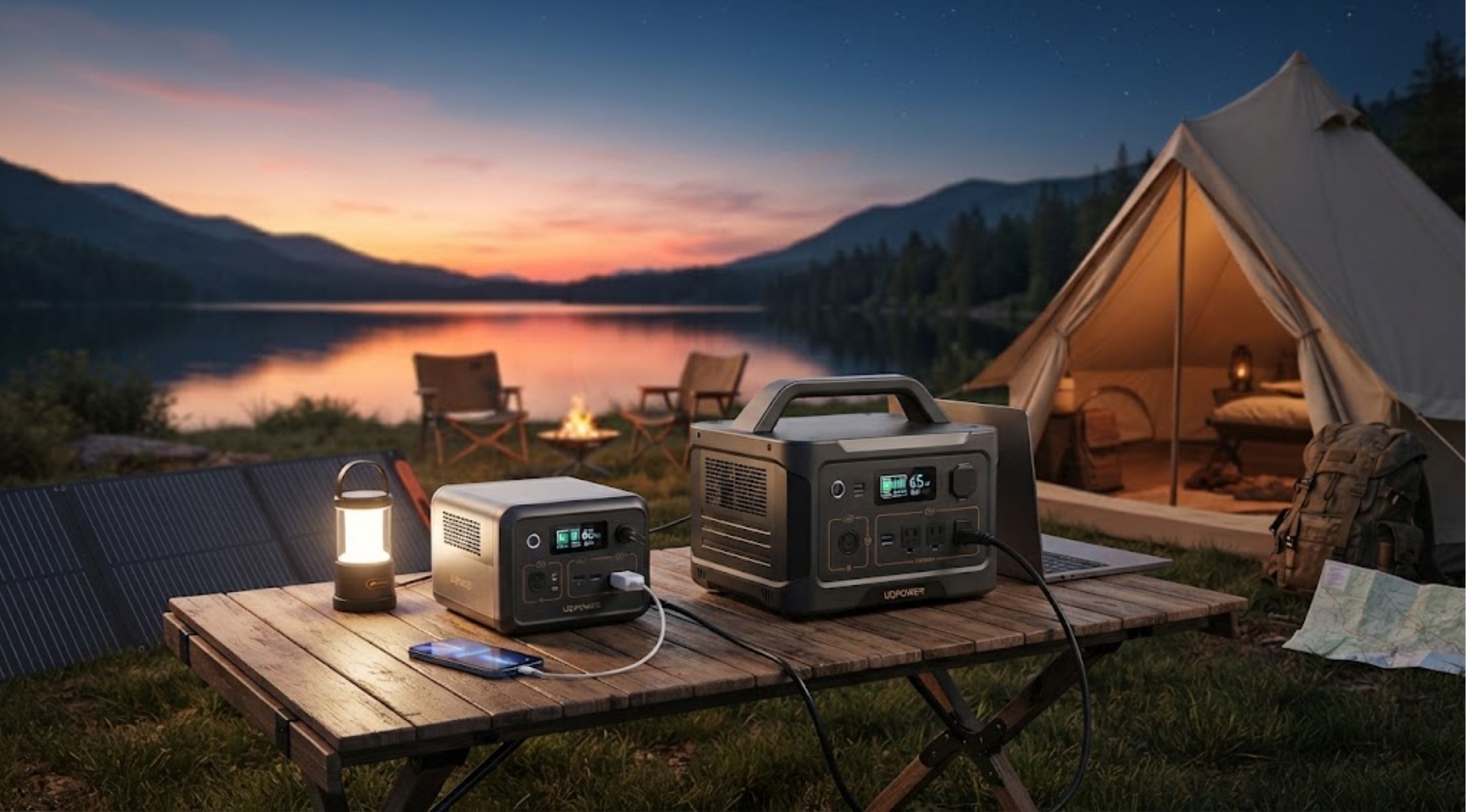
UDPOWER's current C200, for example, has a 192Wh battery and 200W rated output, while the C400 provides 256Wh and 400W output. The company positions these smaller models for uses such as short trips, camping, phones, cameras, lights, and other compact loads.
For longer backup periods or more demanding equipment, a larger unit may make more sense.
UDPOWER's S1200 offers 1,190Wh of capacity and 1,200W output, while the S2400 provides 2,083Wh and 2,400W output.
Should You Choose a Solar Generator?
A Solar Generator can be particularly appealing if you want to recharge without relying entirely on a wall outlet.
Despite the name, modern solar generators generally don't generate electricity from fuel. They combine a battery-based power station with solar panels that can recharge the stored energy.
This can be useful for camping, RV trips, remote locations, and certain backup-power situations.
The amount of solar input matters, though. A larger battery isn't automatically better if your available solar panel capacity cannot recharge it efficiently for your intended use.
UDPOWER describes its solar-generator systems as portable power stations paired with solar panels, with charging options that can include wall power, vehicle charging, and solar depending on the setup.
Practical Tips Before Buying
1. Calculate Your Essential Load
Add up the approximate wattage of the devices you expect to use simultaneously.
This helps you determine the minimum output requirement.
2. Think About Runtime
Capacity matters just as much as output.
A useful starting point is:
Estimated runtime ≈ battery capacity (Wh) × efficiency ÷ device power (W)
Actual runtime will vary, so treat this as an estimate rather than a guarantee.
3. Consider Portability
A larger battery generally means more weight.
If you're carrying your power station to a campsite, loading it into an RV, or moving it around the house, weight and dimensions can become important.
4. Check Recharge Options
Look for the charging methods that fit your lifestyle.
AC charging may be convenient at home, while car charging can be useful during road trips. Solar charging becomes particularly valuable when you're away from reliable grid power.
5. Check Battery Technology
Battery chemistry is another important consideration.
UDPOWER's current lineup uses LiFePO4 batteries across its C-Series and S-Series portable power stations, with the company highlighting long cycle life and solar-ready designs.
When Upgrading to a Premium Power Station Makes Sense
You don't necessarily need the biggest Portable Power Station available.
However, upgrading can make sense when you need longer runtime, higher output, more connection options, faster recharging, or a system that can support more demanding equipment.
For example, UDPOWER's larger S-Series models are designed around higher-capacity backup applications. The S1200 is positioned for uses including refrigerators, CPAP machines, routers, and longer overnight backup, while the S2400 is designed for larger loads and heavier-use scenarios.
This illustrates an important point: premium equipment should solve a specific problem. You're not simply paying for a bigger battery; you're buying additional capability that may be useful for your particular situation.
Benefits of Choosing the Right System
More Reliable Backup
Having enough capacity for your essential devices can reduce the stress of unexpected outages.
Greater Outdoor Freedom
A Solar Generator can provide access to stored electricity during camping, RV travel, and other off-grid situations without requiring a traditional fuel-powered generator.
Quieter Operation
Battery-based systems can be useful when you want portable electricity without the engine noise associated with conventional generators.
More Flexible Charging
A solar-compatible system gives you another way to replenish your stored energy when grid power isn't convenient or available.
Better Long-Term Value
Buying according to your actual needs can prevent the common cycle of purchasing a system that's too small and then replacing it later.
Final Thoughts
Choosing a Portable Power Station starts with understanding your real power requirements.
Think about what you need to run, how many watts those devices require, how long you want them powered, and how easily you need to transport the battery system.
If you plan to spend significant time outdoors or want an additional charging option for emergencies, a Solar Generator may be worth considering. Just make sure the battery capacity, output, solar input, and portability match your intended use.
UDPOWER currently offers everything from compact C-Series models for lighter portable applications to larger S-Series systems designed for higher-output home and RV backup. Its solar-generator range also combines power stations with compatible solar panels for off-grid charging.
The smartest purchase isn't necessarily the largest or most expensive model. It's the system that provides enough power for your actual needs without adding unnecessary cost or weight.
Take a few minutes to calculate your essential loads before shopping, compare the specifications carefully, and choose a power solution that fits the way you really live and travel.